Monday, 11 January 2016

Before we go our separate ways


So before I say good bye, and we go our separate ways, I thought I would just take a few minutes to conclude some key findings and reflect upon my blog and blogging experiences.
 Long range pollution is a topic which is not that widely discussed, and something which i knew nothing about prior to this blog. Many long range pollutants have similar warming properties to greenhouse gases and therefore should be controlled to prevent further warming in the Arctic. Not all pollutants alter the climate, mercury for example, is extremely toxic (in large concentrations) for animals and humans in this region, and the negative impacts of these must not be ignored. Within this blog I have called for more attention to be drawn to these LRP and if I have enlightened just one person, then I see that as a success!

However the realistic truth is all too looming. As temperatures rise pollutants from more southern locations (warmer and wetter) can penetrate the Arctic dome and contribute further to the volume of pollutants concentrating in the Arctic, Also, long range pollution may well become localized pollution in the near future! As sea ice depletes, more shipping paths will open up, resulting in a greater number of vessels in the Arctic. Increased traffic will see greater sulphate and black carbon emissions, as pollutants no longer have to travel hundreds of miles to reach the Arctic. To prevent this, policy makers need to establish long range pollutants as a threat and begin to incorporate them in global mitigation plans. 
I'm sorry LRP but your passports are out of date....


In my first post I stated several aims so i thought i would just reflected upon how I believe I have completed these aims:

1)      To introduce other threats, beside climate change caused by green house gases, to my readers: throughout this blog I have a running argument that climate change as a result of GHGs overwhelms the public eye. I hope, after following my blog, you can understand and appreciate long range pollutants also pose a risk to the Arctic.
2)      I want to present topics which may be very scientific to my readers in a way which everyone, from whatever academic background, can understand and engage with: within my blog I explored topics including the influence of aerosols and bio-accumulation of mercury, both of which are challenging and very scientific topics. I put my hands up (and this particularly applies to the clouds blog post in which I had to read a lot of physics papers) these topics can be very heavily science based which is not everyone’s cup of tea. However, I hope I manged to express these topics in both an accessible and engaging way.
3)      Try and encourage people that these issues do matter and they should act to save the Polar Regions: this l aim is slightly harder but from the response I have had to my blog I do believe I have managed to change some people’s opinions and as to acting to save the Arctic check out my post on deodorant for an inspiration on what you can do to save the Arctic!
4)      To learn and teach other about something I have never personally learnt about throughout my geography studies: Finally I know I have completed this aim! I have learnt so much about the issues within the Arctic and to my surprise have begun to feel quite passionate about some of the topics! I have even changed the deodorant I use to one which does not emit aerosol! Also, based on the comments and other forms of feedback I have had about my blogs I was thrilled to hear people have learnt (and seemed to have enjoyed doing so) about the topics surrounding Long Range Pollution in the Arctic.

This blogging experience has been one of the most rewarding and yet challenging I have undergone throughout my university life. Throughout the last few months I have encountered a few challenges including addressing some very scientific topics. However with hard work and patience I have found I can address any subject no matter how technical it is. Secondly the engagement was something I initially found disconcerting. Positive comments are always a pleasant experience but ones which challenge you argument or your opinion I found harder to address! Yet, it was very interesting to see how others arguments varied from my own and encouraged me to become more critical of my own arguments.

Despite these challenges I have thoroughly enjoyed developing my blog and have learnt skills which will help me throughout my final year at UCL. So I hope you have learnt something and enjoyed reading this blog as much as I have enjoyed writing about it. If you have any questions either about long range pollution (something I now consider myself to be highly knowledgeable about!) or starting up the blog just drop me a message in the comment section and I will get back to you ASAP!

I know Harry Potter has nothing to do with the Arctic but this is a classic!

So all that is now left to say is GOOD BYE!

Friday, 8 January 2016

The results are in!

The results are in! The public have voted (and thanks to all of those who did!) and as expected global warming has come out on top! Exploration of oil comes in second and Long range and localized pollution coming joint third with no votes!

The Results of the poll. 
Upon reflection I should have said GHGs as opposed to global warming, as I have learnt now some long range pollution can also have warming properties. However after discussing with those who voted for global warming as the largest threat to the Arctic, stated that they associated greenhouse gases with global warming.

After spending the last few weeks exploring the dangers (and some positives) or long range pollution I find it boggling that NO-ONE voted for long range pollution, people don't seem to be aware of how damaging they can be! This is feel is reflected in the policies (as a mentioned in an earlier post!) as despite being present, long range pollution policies are often swamped by their cousins Green House Gases. I feel the media also has an influence (as it always does!) by focusing reports on the effects of Carbon Dioxide. “It is thought a natural warming and cooling cycle could be responsible for up to 30% of the melting - but the rest is the result of human activity releasing greenhouse gases” NOT TRUE!

Well I believe it is time Carbon Dioxide moved over! One of the main aims of my blog was to open your eyes to some other pollutants who threaten the future of the Arctic. In my next post, in which I will be concluding this blog and expressing my final opinion on the subject. In the meantime let me know your opinion by commenting! Has it changed throughout the course of the blog?

Wednesday, 6 January 2016

Mercury and Ecosystems 2: Bioaccumulation

Moving on from bio-magnification as this post is going to focus on bioaccumulation in predators at the top of the food chain and the consequences of having a build-up within an animal or human system. So I’m just going to jump straight in!

Top of the food chain
For those at the top of the food chain this large accumulation of mercury, within their system, can be detrimental to their health. There are two ways which the toxicity of mercury can be assessed in predators. Firstly the comparison of the total amount of mercury in an animals system to calculated thresholds. These thresholds are based on a database of known concentrations, calculated from lab observations. The second approach includes examining animals for mercury biomarkers. Biomarkers are certain behavioural responses by animals. As Arctic animals are exposed to many different types of pollutants these markers allow effects of mercury to be specifically identified. Mercury is often stored within the liver of marine mammals and the kidney of terrestrial mammals. One of the reasons mercury is so toxic results from it’s potential to cross the blood brain barrier. This causes a disruption of the nervous system and symptoms such as numbness and decreased co-ordination in large terrestrial mammals (ie. polar bears). Furthermore this toxin can be passed from mother to baby though the placenta or milk, both considerable causes of mercury exposure in new born animals.

Mercury concentrations in Human and polar bears.


Concentration of mercury in pregnant women in the Arctic
What I found shocking, from this graph (above), was the high levels of mercury found in humans! However upon further consideration this isn’t so shocking. Humans are at the top of many food chains within the Arctic, with seals and fish provide an efficient protein source in this region. Arctic indigenous communities are particularly prone to mercury exposure due to their traditional cultural practices of hunting and fishing. Negative impacts of the bioaccumulation, of large concentrations of mercury within the human system, can affect the reproductive and cardiovascular systems, and cause neurotoxicity. These impacts are leading to Arctic residence having to make a choice between the readily available food source and potential health risks associated. Like in many animals, mercury can pass through the placenta to an unborn human child, because of this many studies focus on monitoring mercury levels in the blood of pregnant women. Recent awareness of the impacts of mercury have seen a decrease in mercury concentrations in blood since the 1990s but the graph still shows high concentrations in pregnant Inuit women in Greenland (above).


Within academia there seems to be a lot of ambiguity of results of studies, some establishing bioaccumulation in food chains were others stating they do not exist. Inconsistency of findings may be due to the difficulty of measuring trophic structures and the movement of the element. Publishing bias must be considered, as journals are unlikely to accept studies which do not show any notable relationship between mercury. Simply from my own reading I have found a great consistency between results of studies with most food chains displaying some form of bio magnification and bioaccumulation. I found this a very interesting but alarming topic! So if you have any thoughts on this topic please let me know by commenting.

Mercury and Ecosystems 1: Bio-magnification


My previous post introduced a new pollutant to the blog. Just to recap, mercury is a toxic element accumulating in the Arctic at a rate of 80 to 140 tonnes, per year. I wish to move on today by looking at some of the major impacts of mercury on Arctic Ecosystems. Unlike the other LRP I have explored mercury does not influence the climate in the Arctic. Mercury has the potential to bio-magnify in food chains, entering at the bottom and passing though the trophic stages to larger predators. Traces of the substance has even been found in human blood! Due to the amount of literature on this topic I have decided to split it into two post; the first discussing bio-magnification and the second bioaccumulation.

Entering the food chain
To enter a food chain mercury has to be in a state which can be readily consumed by Arctic organisms. Most organisms (not including those at the bottom of the food chain eg. Algae) cannot take up inorganic mercury. Upon conversion to methylmercury (by bacteria in oxygen depleted environments) the toxin is easily taken up by animals. Production is dominant around ocean waters which contain layers of concentrated nutrients, but little is known about the rate of conversion by this bacteria.

Moving up the food chain
Image result for polar bear looking cute
Un-bear-able Cute!
But these guys often have less mercury in their system
 that predators further down the food chain!
Once entering the food web methylmercury progresses from prey to predator up the web. A “bottom up” process is most common within the Arctic, as focuses on “factors that influence the extent to which methylmercury concentrates at successive tropic levels of the food chain”. This “bottom up” process is also prone to bio-magnification at each tropic step of the food chain. For example, the bio-magnification of an ecosystem in the Gulf of the Farallones was measure to have a trophic magnification factor of 0.32 (this is slightly lower than an average food chain as the Farallones food web is dominated by sea birds, who accumulate mercury differently to other organisms. Furthermore the study was based on the sampling of many tissues including their eggs, so comparison to studies based on muscle tissues may not be representative). As mercury moves through the chain the level of mercury can amplify by approximately 2-7 times, so in the case of a very long food chain, predators at the top can contain methylmercury levels up to a million times greater than those which initially digested the toxic. An expectation of this was found by Atwell et al (2011), who state polar bears demonstrated a lower mean mercury concentration than their prey (ringed seals in this case).
How mercury can enter and leave the system of a polar bear and seal
As mercury is bio-magnifies through a food web it lead to bioaccumulation within predators at the top of the food chain, which can result a series of unwelcome consequences. Stay tuned! My post of bioaccumulation will be coming very soon!

Monday, 4 January 2016

Mercury: Headlining the Arctic

Ladies and gentlemen please welcome to the stage a new form of long range pollution… Mercury! *APPLAUSE*. This post aims to explain what mercury is, where it is from and its presence in the Arctic region. Despite being a remote region, the Arctic has accumulated high levels of Mercury. The element is having many negative implications for the biota in this region thus creating a topic of both interest and concern.

Image result for mercury arctic cartoon
Mercury is headlining the Arctic.
What is mg?
Mercury (Hg) is a naturally occurring element. With a very low melting point of -38.87 degrees Celsius, mercury is most often found as a silver liquid. Before the industrial revolution the total amount of mercury in the environment was in equilibrium. The anthropogenic creation of mercury has upset this balance causing excess mercury to be found in the soils, surface water and oceans (all of which are large global stores of the element).


Map showing Mercury released into the atmosphere
tonnes per year
Sources of Mercury.
The natural abundance of mercury, in the environment is doubled, by that produced from human innovation (about 4000 tonnes). Burning coal is by far the largest production of man-made mercury, followed by the smelting and metal production industries (as Hg is used in the creation ferrous and non-ferrous metals). A larger proportion is generated through the mining industry, which uses mercury to extract from gold natural ores. “Hot Spots” for release of atmospheric mercury include China, Sudan and the North West Coast of South America, demonstrated by the map (right).


Chart showing the sources of anthropogenic
Mercury.

Mercury’s presence in the Arctic.
It has been estimated that the net amount of mercury added to the Arctic environment each year is between 80 to 140 tonnes (NB: mercury is also leaving the Arctic system). Most of the Mercury present in the Arctic is transported by prevailing winds, ocean currents and rivers. Atmospheric pollution, from mid latitude power stations, can take as little as a few days to be transported from source to the Arctic. Transportation through the atmosphere can have detrimental impacts as gaseous Hg can have a lifespan of up to a few months (within this time a mercury atom has the potential to circulate the majority of the northern hemisphere).
The oceans are also a great transporter of Hg, yet a much slower method of distribution. However, it is important to remember the amount of mercury reported in the atmosphere is smaller in comparison to the volume stored in the oceans.

Mercury budget in the Arctic Ocean.
The Mercury budget, for the Arctic Ocean, suggests the Atlantic and Pacific oceans, coastal erosion and the atmospheric (through mercury depletion events during spring) are all large inputs of mercury to the Arctic system. The proportion of mercury sourced from atmospheric deposition demonstrates the large surface area of the Arctic Ocean. The outflows of mercury are less apparent including sedimentation, the removal through ocean systems and to a very small extent the remission of gases. The disproportionate ratio of inflows to outflows demonstrate why the Arctic is a site of mercury accumulation.

Modelling the Arctic mercury budget must be completed on a global scale to incorporate the influence of long range transport. A large scale results in a greater level of uncertainty associated with the models as resolution of results are low. This can be overcome by using a multi-scale approach (using models which integrate global and regional scales) which is adopted within a study published in the Atmospheric Environment Journal. Within the paper Dastoor and Larocque use a global/regional atmospheric heavy metals model to simulate the movement of mercury within the atmosphere, allowing a higher resolution to be obtained.

Stay tuned for my next post which will delve deeper into the impacts of mercury on ecosystems in the Arctic. Until then please comment any questions or thoughts you have in response to this post.


P.S. For those of you who found the topic of mercury particularly thrilling this website http://www.mercurywatch.org/ is well worth a read. The site monitors the use of mercury across the world in small scale gold mines. Sponsors aid projects which aim to reduce mercury production by training workers to use mercury free extraction methods in Ghana, Senegal and Burkina Faso. Benefiting both the environment and the health of works. 

Saturday, 2 January 2016

Why don't Black Carbon and climate models get along?


Modelling the impacts of Black Carbon (BC) is in abundance in academic geography. However, only recently has Black Carbon begun to be incorporated into studies modelling climate change (ie. ice sea ice retreat) within the Arctic. Either models have advanced (and details such as BC can be accounted for) or black carbon has just been established as contributor to climate change in the Arctic, I do not know. This post sums up my series on black carbon as a form of long range pollution and aims to discuss the presence of black carbon in modelling studies by comparing two studies.

Published in 1995, Cattle and Crossley, discuss the basic predictions of climate change in the Arctic region. The model adopted is that used by the Hadley centre for climate prediction and research at the meteorological office, to model the impacts of future climate change resulting from increased concentrations of greenhouse gases. It is important to remember climate change did not become a global phenomenon till the late 20th so this knowledge was quite new at this time. The results suggested a temperature change by approximately 2 degree centigrade by 2030 (this is based on Greenland predictions but generally results varied very little), thus causing a thinning of ice and a maximum ice thicknesses of 3m in March and 2m in September (within the central Arctic).

This seems to be a very large underestimate of what has occurred over the past 10 or so years. Currently, 4 years before the predicted temperature rise, parts of the Arctic are witnessing temperature rises of 2-3 degrees PER DECADE! So by 2030 this temperature change will be well above what the model simulations in Castle and Crossley's study. This gap between predicted and observed results could have resulted from a lack of consideration of the albedo feedback systems created by black carbon. Having said this it is unlikely black carbon could be able to single handedly cause an accelerated rate of sea ice retreat. Graversen et al (2008) suggest black carbon and the resulting change to albedo could contribute to the warming when associated with warming of the middle troposphere (as a result of an advection of energy bringing warmer air into the Arctic region).


Map showing sea ice retreat.
In order to accurately predict abrupt sea ice retreat, anthropogenic forcing, such as the influence of particulates, must be incorporated within Arctic Models. Holland et al (2006) incorporate changes to albedo (as a result of anthropogenic particulates) as a forcing of sea ice reduction. The study concludes major summer ice reduction could be expected as early as 2015. A focus is placed on the influence of surface albedo feedbacks accelerating retreat. So we are currently in 2015 and have experienced the predicted sea ice retreat. The map (Right) shows the sea ice retreat between the extents in December 2015. The magenta line represents the median ice edge for 1980-2010 and just illustrates the overall sea ice loss occurring within the past 5 years.


To sum up, in order to create accurate simulations, models must include anthropogenic forcing from pollutants such as black carbon, to realistically represent albedo feedback systems. The extent of the influence of black carbon on warming is questionable and some studies such the UNEP/WMO Assessment, conducted by the World Bank, does not consider the forcing properties of the particulates. The influence of sources of black carbon in this study is deemed so insignificant (in comparison to other forcing factors), so it is not included. Furthermore the level of uncertainty associated with the calculation of the forcing effect of black carbon is so high it contradicts it inclusion in some cases. However, the literature still generally suggests to achieve realistic results black carbon should be included in Arctic models. 

Wednesday, 30 December 2015

Black Carbon policy 2: My thoughts.

Only in the past few years have we begun to see the integration of black carbon into policy. Reduction of sea ice, within the Arctic, is becoming ever pressing and require the movement of policies from move from local legislations onto the global platform, in order to reduce BC emissions. There is a substantial body of scientific research explaining why BC policies should be put in place, so why is there a gap between the science and the implementation of global policies? Within this post I aim to reflect and discuss some of the thoughts I have had surrounding this topic of Black Carbon and the related polices in response to a  recent article in the Nature Journal.
Is this how we are viewing climate change?
We know BC is causing warming. So why are we not acting?
Heath- a motivator for change?
For many reducing Black Carbon for the sake of the Arctic is not a huge motivator. Health implications, associated with BC, are more of an encouragement to other global bodies to promote emission cuts. For example if the BC production was halved by 2030 approximately, 2.4 million premature deaths a year could be avoided.

However, the House of Commons Audit report (addressing the threats to the Arctic) states “Black carbon is a climate and health problem. If policy makers continue to consider black carbon as only a health and air quality problem we will fail to optimise the climate and Arctic benefits from Black carbon”. For policies to be beneficial, political bodies must first recognise the climatic issues of BC (as well as the health issues) and then incorporate this into the decision making process.

Climate and Air quality polices.
Furthermore, whist researching both climate change and air quality policies (which BC would fall under) all I seem to find is a contradiction. An example of this is biomass burning. The burning of biomass reduces Carbon Dioxide in the atmosphere but causes a greater volume of Black Carbon to be released. This just seem madness to me! Policies combating climate change and BC need to walk hand in hand (eg. Switching to renewable energy sources) as opposed to many of the ‘either-or’ decisions currently in place.

Agree or even disagree with my thoughts? Let me know by commenting!


Monday, 28 December 2015

Black Carbon Policy 1: Wherefore art thou

As with any environmental issue, policies are implemented to mitigate and prevent any further damage. Yet black carbon is yet to be the latest craze for policy makers. Highwood and Kinnersley (2006) argue mitigating Black Carbon (BC) emissions has the potential to act as a short term fix for global warming. If this is the case then why are global policy makers not incorporating this form of pollution?

International Long Range Pollution policies.
Long Range Pollution was introduced to international climate policies in 1979. The Geneva Convention on Long range Transboundary Air Pollution was signed in 1979 and implemented in 1983, being the first policy which recognized the issues of transported pollutants. The most recent international agreement, the Gothenburg Protocol implemented in 1999, set limitations on aerosols (sulphur dioxide and nitrogen oxides), organic compounds and ammonia to be achieved by 2010. Upon completion Europe aimed to reduce sulfur emissions by approximately  63% (in comparison to 1990).

A further policy which focuses on long range pollution is The Climate and Clean Air Coalition, which consists of a series of governments, civil societies and private sectors from countries including Bangladesh, Mexico and the US. The coalition targets methane, Black Carbon and HFCs by raising awareness of these short lived climate pollutants.

Despite this recent incorporation of BC across several political innovations, the pollutant still seems to be lacking across the global environmental scene.The IPCC 5th report (published in 2013) introduced aerosols and their radiative influences for the first time, yet Black carbon is still nowhere to be seen. It is the incorporation of BC into these global policies and research studies, such as the IPCC, which will help to reduce emissions.


Within the Arctic.

Black carbon in Yukon.
 Should the Arctic really be looking
like this? 

Policies still seem to be few and far between. To combat this issue of long range BC such policies must be integrated on a global scale, and not just by the countries who will come off worse! It seems many of the international climate debates are focused on Green House Gases and ignoring most other forms of pollution. In order to reduce BC emissions and benefit the Arctic this must change! 
Black carbon is a more pressing issue within the Arctic for reasons discussed within my previous post. As a result of this a greater number of policies incorporate black carbon reduction in their plans. The Arctic Council, in particular, play a large role in addressing the issues of black carbon. The Council’s most recent report discusses a framework of action, in which they aim to raise awareness of the black carbon as a climate issue and include stakeholders and national governance in the implementation of international mitigation agreements. Recently, members from the Arctic were present at the COP21 debates, where they spoke about the role of BC in the Arctic. However GHG’s remained the pressing feature of the conference (nothing new there!). Despite the work undertaken by the Arctic Council, still only Norway has developed a national specific plan to reduce SCLPs (Black carbon included within this).

Thursday, 24 December 2015

Black carbon: The dark horse of global warming


Arctic Haze if one of the main effects of Long range aerosols in the atmosphere. 90% of haze consists of sulphate and nitrate particles and the reaming consists of black carbon and hydrocarbons. What really interests me is the warming effects caused by black carbon (or soot) in the Arctic region. Black carbon sits at the other end of the spectrum to reflective aerosols (such as sulphates), absorbing solar radiation and warming the surface temperatures.

The picture shows the impacts black carbon
(and other aerosols) can cause on limestone buildings.
BC is caused by the incomplete combustion of organic matter (including either organic matter, from forest fires, or anthropogenic, as a result of fossil fuel combustion) and consists of 5-10% of particulate matter found within urban areas in the US and Europe. Across the globe, black carbon can have detrimental impacts on local climate and health. This is particularly an issue in Venice where buildings are falling victim to the deposition of black carbon.

Warming, caused by black carbon, is particularly profound in the Arctic region due to the sensitivity of feedback systems which occurring there. Black carbon, within Arctic haze, absorbs incoming infra-red and converts this to ultra violet radiation, resulting in warming. Deposition of BC also reduces albedo (lowering the ability of the snow covered surface to reflect) and absorbs radiation (directly on the surface) therefore creating localized warming. Such reduction in albedo can have similar climatic effects as GHGs, in terms of summer sea ice reduction. Highwood and Kinnersley (2006) challenge this by stating the direct forcing of aerosols could make changes of 0.5Wm-2, which only accounts for approximately 1/3 of the warming caused by carbon dioxide and other greenhouse gases. The degree of warming is still uncertain but it is certain that BC is contributing to climate change.

Other, indirect impacts of BC can alter the properties of clouds. When combined with sulphates, in the atmosphere, black carbon can also influence the size of water droplets in clouds.

Furthermore, black carbon particulates can pose as carriers for other toxins. There surface area (of carbon particulates) provide an area for other chemicals, such as polycyclic aromatic hydro carbons, to rest upon and be transported into the lungs. Koelmans et al (2006) argues the presence of BC may be positive. Their paper states the presence of this particulate can make toxic chemicals (on the surface of BC) less available for biota. So maybe it isn’t all bad! However both black carbon and the chemicals transported on its surface, can have serious health implications for humans and other mammals in the region.  


So remember, whilst you are sat in front of your roaring fire this Christmas, the black carbon produced could be causing the Arctic to melt… Leave a comment with your thoughts! 

Sunday, 20 December 2015

Sulphates: The light in the dark


Not all aerosols warm. Sulphate particles, for example, can cause a dip in surface temperatures as a result of their ability to reflect infra-red radiation. For geoengineering purposes (Solar radiation management) or a “quick fix” against climate change, sulphates have provided a shining light as a new method to combat rising temperatures. Aerosols, injected into the atmosphere, reflect solar radiation back into space, thus preventing it reaching the earth’s surface. This is hoped to contradict the warming effects of greenhouse gases.

Najafi et al (2015)
So back to the Arctic…

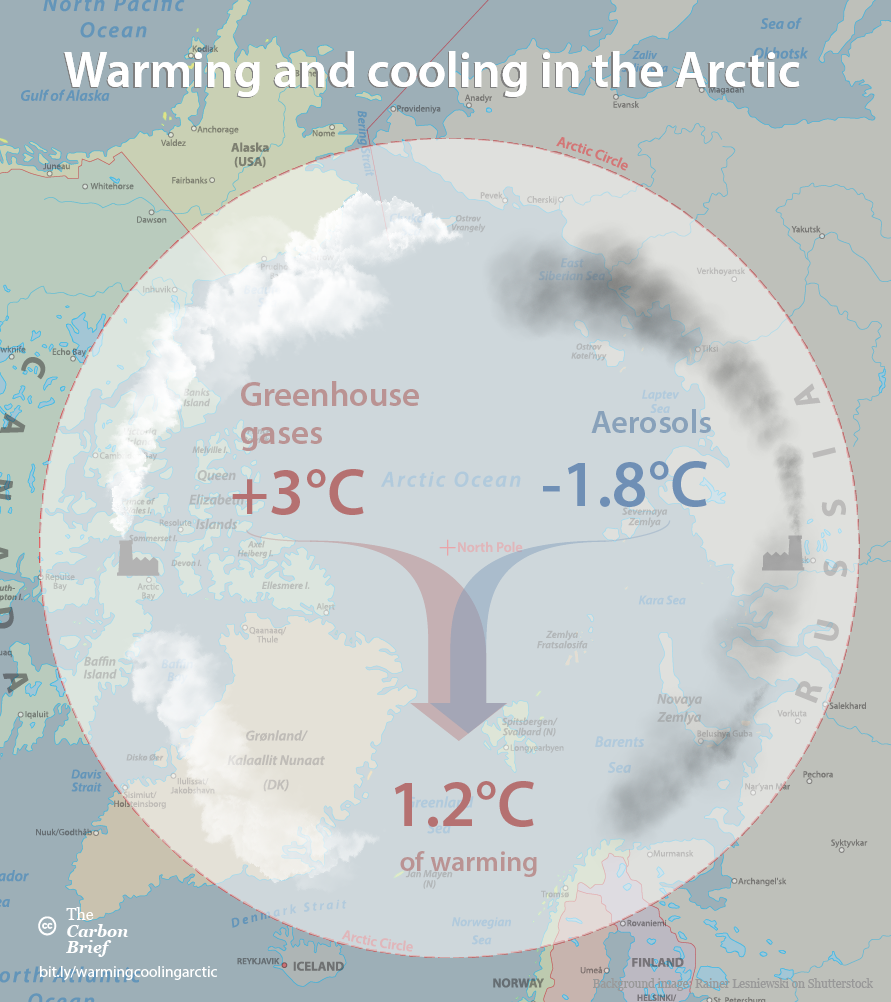
Warming is occurring at an amplified rate within the Arctic. A study recently published in Nature Climate Change suggests aerosols could be used as a method of slowing the rising temperatures. The paper highlights the ability of aerosols to scatter radiation and cause clouds to form. Modelling results suggests greenhouse gases were going to cause a 3 degrees Celsius warming over the Arctic, yet the rise in temperature currently stands at only 1.2. The difference between predicted and observed can be accounted to the cooling influence of sulphates. This demonstrates the potential of SRM schemes, especially in the Arctic.


It is important to remember SRM, as a method of mitigating climate change, does not come without risks. A friend of mine covers the topic of Solar Radiation Management in her blog and highlights the risks associated with this type of geoengineering. Aerosols only influence the climate for approximately 2 years before being removed, from the atmosphere, by precipitation. A greater concentration of sulphates can result in a lower pH rainwater (acid rain). Secondly, the uncertainty associated with these methods is still high and the failure of these schemes could subject the earth to rapid warming, at a greater rate and to higher temperatures than current.

Thoughts:

Before I began engaging with the literature surrounding this topic I recorded my initial opinion as I was interested to see if it had changed: “I believe geoengineering is not a good mitigation strategy. Messing with the natural climate system will only end badly and the negative impacts of aerosols (in the Arctic especially) has not been considered holistically. Based on what I have read this is not going to be a long term fix for climate change. In the Arctic, aerosols have a series of negative effects including changes to the composition of clouds, which has not been considered.”

I started this blog seeing all types of pollution as negative, but after reading this I have been shown that aerosols are not all bad. Any method which can slow the warming in the Arctic must be positive! However the future isn’t so bright. Predictions show anthropogenic productions of aerosols are predicted to decline (whilst greenhouse gases continue to rise), indicating rate of warming within the Arctic will increase in the near future.


This is a very controversial topic and I would be very interested to hear your opinions so please comment and let me know! 

Tuesday, 15 December 2015

Would you stop using deodorant to save the Arctic?


Scientific topics tend to dominate the discussions of long range pollution so I thought I would divulge away from this for a week and focus purely on the use of spray aerosols deodorants. Deodorant is part of everyone’s morning routine (or so I would hope!) but I doubt many of us consider the environmental impacts associated with the product.

The canned deodorants use aerosols (such as Nitrous oxides) to propel the product out of the can. Previously, CFCs were used but after the negative effects (depleting ozone) were established, companies moved to aerosols thinking they were a better alternative... I have touched upon both the direct and indirect impacts of aerosols in the Arctic now and can conclude they are having a series of negative effects on the Arctic’s climate. Switching from spray deodorant could be just one of the things YOU could do to reduce aerosol emissions. 

Implementing change
As with any environmental policy there are debates to who should be responsible for implementing change. One option is encouraging a bottom up approach and ‘leave it to the people’. Dryzek (2012)* argues people need to give up cherished ideas to project the environment and us as individuals need to make conscious decisions to become more environmentally aware.

However in order for this to be successful you would need to change a series of social practices which are embedded in daily our routines. An example of this is the use of spray deodorants. There are several reasons why this may be difficult, creating what is referred to as the value action gap. Firstly many people would struggle to conceptualize the idea that spray cans could be causing warming in the Arctic, this removes the motivation to change. Secondly, many individuals dismiss that changing a small aspect of their daily routine may be able to make a difference; many believe a single persons actions will not be able to combat such large scale problems.

Graffiti Wall cartoons, Graffiti Wall cartoon, funny, Graffiti Wall picture, Graffiti Wall pictures, Graffiti Wall image, Graffiti Wall images, Graffiti Wall illustration, Graffiti Wall illustrations
Ironic eh? But i thought this image demonstrated the issue
 of the Value Action Gap pretty well... why are our intentions
so different from our actions? 
Personally, I don’t feel I will be receiving the same antiperspirant protection from role on as I do from spray deodorant. Smelling, in today’s society, is viewed as totally unacceptable and this fear keeps me reaching from my spray can every time. These factors will make it very hard to persuade the average consumer to make such a change for the sake of the Arctic and continue to fuel this value action gap.  

Despite being an interesting topic, the impacts of spray cans cannot be compared to the large influx of aerosols from other sources. Aerosols can originate from a range of sources including smoke produced by tropical forest fire and burning of fossil fuels. Production of aerosols is concentrated in the northern hemisphere, mirroring extensive industrial activity. Rhan (1980) argues aerosols found within the Arctic are primarily from Eurasia, with small proportions also from North America and Eastern Asia. Now I know this reference is old, but this just illustrates aerosol pollution is a long standing problem which still remains today. Fisher et al. (2011) supports this by also stating large volumes of aerosols “from East Asian and European anthropogenic sources… growing contribution from North America”. However, since this reference was written, aerosol production in Asia and Europe began to decline following the introduction of clean air policies.

Remember...It is important to note I am looking at aerosols as a whole in this post, varying types (sulphates and black carbon for example) all have individual sources. For example large volumes of black carbon is produced from burning boreal forests; however in relation to the total amount of aerosols in the Arctic this volume is minor.

So the question still stands… Would you stop using deoderant to save the Arctic? (Comment and let me know!)


*Dryzek, J.S. 2012. The Politics of the Earth, Oxford University Press, Oxford

Thursday, 10 December 2015

Clouds: The innocent bystanders of long range pollution


So carrying on this long range pollution theme, and a particular focus on Aerosols, I wished to burrow deeper into the literature of the impacts of aerosols in the Arctic. Within this post I aim to open your eyes to another impact, in the Arctic, which you may not have heard about before; the impacts of aerosols on clouds.

Sulphate aerosols, in particular, can alter the micro-physical properties of clouds. "Aerosols in the lower atmosphere can modify the size of cloud particles, changing how the clouds reflect and absorb sunlight, thereby affecting the Earth's energy budget". Changes in the energy budget have played a role in causing amplified warming in the Arctic. Kay and Gettelmen (2009) argue that feedback systems, created by changes to cloud composition, can be held accountable for the great loss of sea ice during the 2007 event.


I bet you don’t think about the clouds when you think of the impacts of
 long range pollution in the poles, do you?

Impacts of aerosols on clouds
A series of complex interactions link clouds, aerosols and sea ice in the Arctic. Aerosols can act as both a warming and cooling agent in this case. Clouds, in the Arctic, can also have “an annual-mean net warming effects on the Arctic surface”. When surface temperatures are cooler than internal temperature of low clouds, infra-red radiation emitted from clouds, warms the surface. The presence of long range aerosols can alter the mirco-physical properties of the clouds and consequently alter the annual net energy budget (this factor is often ignored when modelling Arctic change). This influence on the natural energy budget is refereed to as the aerosol indirect effect.

Changes to the effective radius of water droplets can have varying implications of the surface energy budget. Optically thin spring time clouds typically contain low droplets concentrations. The presence of aerosols causes a greater number of smaller water droplets, consequently optimizing longwave emissivity of clouds and increasing surface warming. A 50% change in the radius of water droplets can alter the energy budget by 40 W m^-2.  

In many cases a mixture of aerosols black carbon can increase water droplet size, within the cloud, thus increasing the albedo of clouds and causing surface cooling. However, this is minimal in comparison to the warming influence of clouds, as they already sit above a highly reflective surface (ie snow) (Graversen et al., 2008). 

Sensitivity and Meteorological conditions

Tietze et al. (2011) illustrated the sensitivity of clouds, to long range aerosols, by analysing changes to properties including liquid cloud effective radius and optical depth. Pollutants were identified to have the biggest impact around the freezing point, sensitivity decreases above or below these temperatures. Results also indicated the optical depth was up to 4 times more sensitive (than effective radius) to the presence of aerosol pollutants. This difference was attributed to an unknown feedback system.  

However, simply looking at the properties of clouds does not create a true representation of the systems in the Arctic. To get a true picture, when modelling the influence of aerosols, meteorological conditions should also be incorporated. This is illustrated by the results of Coopman et al. (2015) who contradicted Tietze et al, by stating optical depth and liquid cloud effective radius have very similar sensitivities to aerosol pollution (under similar conditions). Furthermore, localised meteorological conditions influence the extent to which aerosols alter certain properties (increased water vapour within the air can increase the impact of aerosols on cloud sensitivity). Differences in meteorological conditions can also account for the differences between optical depth and effective radius found within the Tietze et al. study.

High levels of uncertainty are associated with modelling studies in the Arctic. I have noticed a there is a large gap between firstly the simulated and observed results and also little consistency between the results of different studies. This uncertainty can often be associated with changes in cloud properties. In particular, the influence of meteorological conditions are often not considered and the incorporation of the scientific knowledge (discussed above) will help reduce such uncertainty.